Performative Pragmatism
On the word that ends conversations instead of advancing them

At a previous company, I attended a sprint planning meeting where a colleague proposed we draft a one-page architecture sketch before splitting the work. It would have taken twenty minutes. A senior engineer cut him off mid-sentence with a single line.
“Let’s just be pragmatic and start coding.”
The room nodded. The sketch died. Three weeks later, we ripped out a service boundary that the sketch would have caught in those twenty minutes.
I have been collecting moments like this for years. The word “pragmatic” gets used to end conversations more often than it gets used to start them, and that asymmetry is interesting. Pragmatism, as Peirce, James, and Dewey set it up, is the doctrine that you evaluate ideas by their practical consequences. It is a position about how to think, not a permission slip to skip thinking.
What I see most engineers doing, when they reach for the word, is the opposite. They use it to mean let’s act now. They use it to dismiss planning. They use it to make impatience sound like virtue. I call this Performative Pragmatism, and once you can name it, you start seeing it everywhere.
Pragmatic about what, exactly?
Here is the diagnostic question that breaks the spell. You ask someone who just played the pragmatism card a single follow-up:
“Pragmatic about what outcome, exactly?”
Pragmatism without a stated criterion is not pragmatism. It is agitation with better PR. Real pragmatism requires that you name the result you are optimizing for, because the whole philosophy is about evaluating ideas by their consequences. If you cannot articulate the consequence you are chasing, you are not in the pragmatist tradition. You are just in a hurry.
In my experience, ninety percent of the time, the answer to that question is some flavor of “we need to ship”. Which is fine, except shipping is not a single number. Shipping fast and shipping correctly trade off. Shipping the first version and shipping the version we will not have to throw away in six weeks is a trade-off. The word “pragmatic” lets the speaker collapse all of these into one flat axis of urgency, and urgency is the easiest axis to defend out loud.
The cost ledger
Engineers tend to forget that there is a ledger here. Pragmatism, in the genuine sense, is about minimizing total cost to a defined outcome. Total. Not just the cost up to the first commit.
If thirty minutes of design saves thirty hours of refactor work, then designing is the pragmatic choice.
Skipping the design to “be pragmatic” is romantic, not pragmatic.
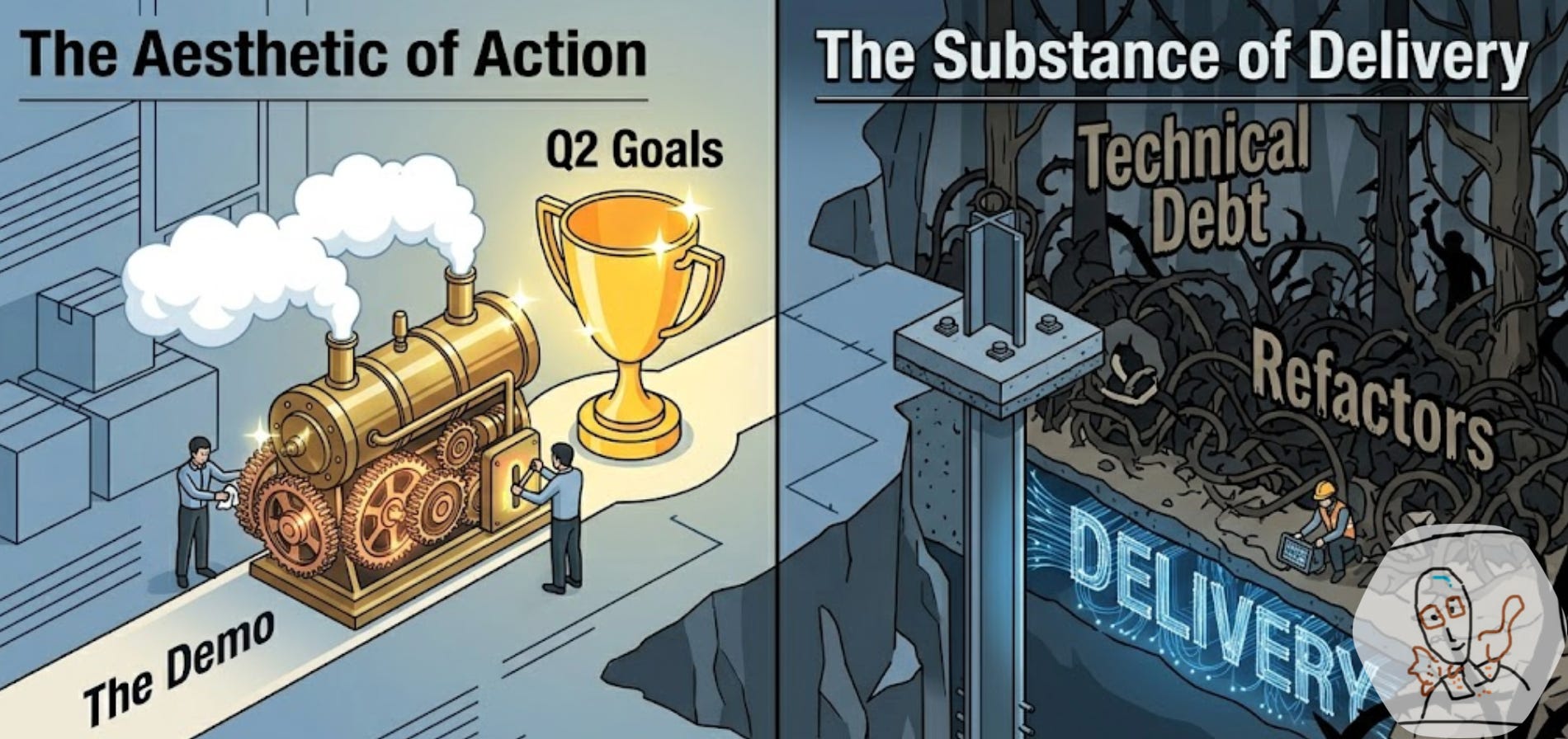
It is the aesthetic of action confused with the substance of delivery, and they are very different things. Sun Tzu had a line that everyone quotes, and almost nobody applies:
Tactics without strategy is the noise before defeat.
I keep thinking about this in the context of what I would call the accounting horizon. People who are about to skip thinking almost always have an accounting horizon that ends at the next demo. They are not lying about being pragmatic. They are being pragmatic over a two-week window. Stretch the window to two quarters, and the same decision looks reckless. The argument is rarely about pragmatism. It is about whose horizon counts.
The Greek
There is a layer underneath the philosophical history that I find even more telling. The word “pragma” in classical Greek did not mean action in the raw sense. It meant matter, affair, the thing at hand, business being conducted. The verb behind it, πράσσω, is closer to “manage”, “transact”, “carry through” than to “do”. When Aristotle uses the word, he uses it for the subject of inquiry, the matter you are taking up. There is a built-in deliberateness to it. A πρᾶγμα is not a reflex. It is a concern you have decided to attend to.
Modern English flattens all of that into something like practical action, with the deliberateness sanded off. In this language, the pragmatic person is the one who acts unsentimentally. The Greeks would have read this as a category error. You can have a pragma that consists almost entirely of careful thought. The word does not exclude reflection. It defines what reflection is for.
There is a small joke here for engineers, and I am not going to be subtle about it. A pragma in a C compiler is literally a meta-instruction. It tells the compiler how to think about the code. It is not the code. It is the layer above the code that governs how the code is processed. A compiler that ignored its pragmas in order to “just be pragmatic” would produce nonsense.
This is not a coincidence. The English word and the compiler directive share a root, and the root carries the same meaning in both directions: the thing that governs how you handle the matter.
We have somehow built an engineering culture where the source code uses the word more correctly than the engineers do.
Action bias dressed up
There is a body of research on what behavioral economists call action bias, the tendency for humans to prefer doing something over doing nothing, even when nothing is the better choice. Goalkeepers dive on penalty kicks far more often than statistics justify, because standing still and watching the ball go past you feels worse than diving the wrong way. Engineers have their own version of this. We confuse busy with productive because busy is visible, and thinking is not.
A planning meeting looks unproductive. No one is typing. The IDE is closed. Compared to the dopamine hit of a green CI run, sketching a sequence diagram on a whiteboard reads as work avoidance. But the highest-leverage parts of engineering work happen long before the keyboard. The cost of getting the abstraction wrong on Monday is not paid on Monday. It is paid in the next quarter, when three other systems have grown around the wrong abstraction and the cost of unwinding it has compounded past the point of reasonable repair.
Performative Pragmatism is action bias with a thesaurus. Same impulse, better vocabulary, harder to challenge.
The thought-terminating function
Robert Lifton, writing about how rhetoric gets weaponized, coined the phrase thought-terminating cliché. A thought-terminating cliché is a short, often virtuous-sounding phrase that ends discussions instead of advancing them.
“It is what it is.”
“Boys will be boys.”
“Let’s just be pragmatic.”
The function of the phrase is not to communicate. The function is to close the door. Once it is uttered, the social cost of continuing the discussion shifts onto whoever wants to keep thinking. They become obstructionists. They become the person slowing down the meeting. The pragmatist, having said almost nothing, has won.
I have noticed that the same person rarely uses the word in both directions. People who say “let’s be pragmatic” to skip planning almost never say “let’s be pragmatic” to skip a feature. The word travels only one way, which is a tell. Genuine pragmatism would cut in both directions. Performative Pragmatism only cuts toward action, because action is what the speaker already wanted.
The counter-move
When the card gets played, I have found that direct confrontation does not work. Saying “but planning is also pragmatic” sounds like sophistry, even when it is correct. The argument is being held on rhetorical ground, and you will lose it on rhetorical ground.
What works better is the sincere diagnostic question. Something like:
“Pragmatic with respect to which outcome, and based on what evidence that acting now produces that outcome better than thinking for fifteen more minutes?”
This is not a gotcha. It is a real question. If the person can answer it, they were genuinely being pragmatic, and the planning probably is overhead. Let them lead. If they cannot answer it, they were performing, and the room can see it. You did not have to call them out. The question called them out.
I have asked some version of this question maybe forty times in my career. The answer reveals everything. The serious people produce a coherent answer in two sentences. The performative people change the subject, accuse you of overthinking, or produce a fog of generalities about velocity and momentum. The signal is loud and fast.
What I actually do
In practice, I have stopped trying to win the rhetorical fight. The fight is rigged because the language is rigged.
What I do instead, in projects under my influence, is establish a small habit that reframes the default. Before any non-trivial piece of work, we write down the outcome we are optimizing for, in one sentence, and the cost ledger we are using to evaluate alternatives. Not a document. Not a spec. One sentence in a Slack thread. Two if the work is complicated.
The habit makes the diagnostic question redundant, because the answer is already on the page. When someone says “let’s just be pragmatic”, I can ask “pragmatic about which line of the ledger?” and there is a real answer to point at. The fight does not have to be fought because the ground has been moved.
I would not call this a process. Processes get gamed. I would call it a pragmatism receipt. A small, written artifact that says: this is the outcome we claim to be optimizing, and this is the cost basis. If you want to short-circuit the planning, fine, but you have to do it with the receipt in hand.
The shape of the inversion
There is something almost funny about the whole thing, in a tired way. Pragmatism, as a philosophical tradition, was originally a defense of careful thinking against those who wanted to argue from pure abstraction. James and Dewey were saying, slow down, look at consequences, take seriously what works. The word “pragmatic” used to mean stop being sloppy.
A century later, in engineering offices, the same word has been rotated 180 degrees. It now means stop being careful. The vocabulary survived. The substance reversed. This is not unusual in how words drift, but it is striking when the drift is exactly opposite to the original meaning.
If the next time someone reaches for it to end a conversation, you ask them what outcome they are pragmatic about, you are not being pedantic. You are restoring the word to roughly the way it was used before it became a club. That is a small civic act, and it is cheaper than the refactor you would otherwise be doing in three weeks.
Pragmatism is not the absence of thought. It is thought directed at consequences. Anyone using the word to mean otherwise is performing.